The measure isn't a number on a tape — it's the animal's behavior. If it stops feeding to look at you, you're already at the edge, and that's your last frame rather than your cue to take another step.
The distance rule: stop sooner than feels necessary
Use the published numbers as a floor, not a target. In US national parks the general baseline is 25 yards (75 feet) from most wildlife and 100 yards (300 feet) from bears and wolves. State parks, wildlife refuges and open space districts set their own rules, and some are stricter, especially during nesting and calving season. Check before you go.
So the practical job isn't sneaking. It's making a frame you actually like from beyond that line. That's a focal length problem and a patience problem, and both are solvable with modest gear.
Signs you're already too close
Read the animal, in roughly this order of urgency:
- Head comes up and locks on you
- Feeding or preening stops
- It freezes instead of moving
- Alarm calls, or other animals nearby going quiet
- It repositions to keep a bush, a rock or a tree between you and it
- An adult moves young away, or puts itself between you and them
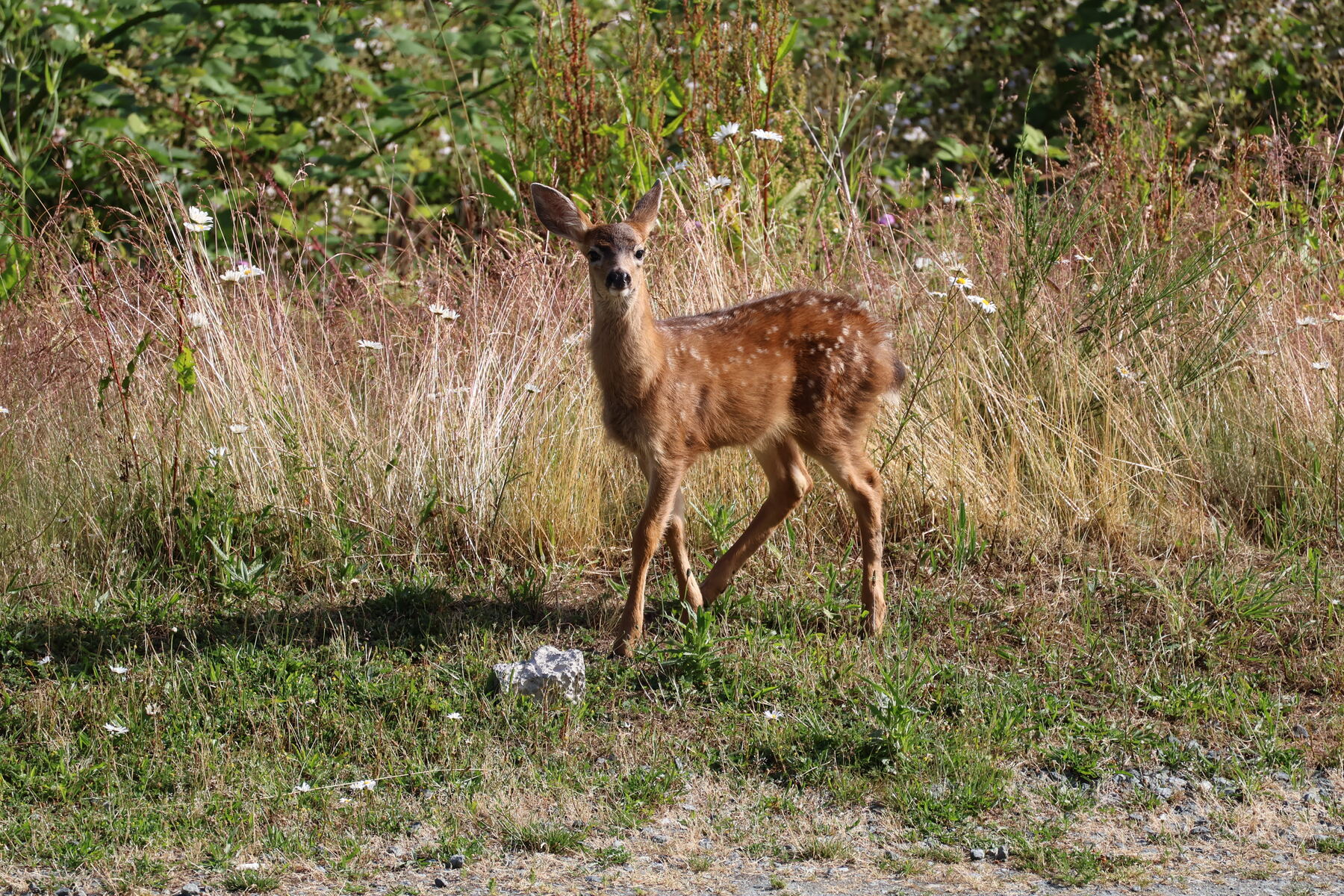
Two of my own frames sit right on that line. On a July morning in Washington I spotted a fawn down a gravel path, shot it at 210mm, and in the next frame it looked straight at me. That's Caught Noticing Me Back — the photo you get right before you stop. I didn't move closer.
Another time, I was in a cemetery when a herd of sheep came through. One ran ahead, turned back, and the whole herd froze. Nothing dramatic happened. But that stillness is the animal telling you where the line is, and it doesn't matter that you didn't intend to cross it.
I'm not going to pretend I've never made an animal notice me. Both of those frames are proof that I have. The useful habit is what you do in the second after you see it.
Focal length does the walking
Reach is the only part of this you can buy, and it substitutes directly for approach. My body is a Canon R50, which is APS-C, so the 1.6x crop factor gives a 400mm lens roughly the field of view of 640mm on full frame. A 200mm zoom behaves like about 320mm. That's real reach on a small budget.
The numbers behind my calmest wildlife frames:
- Heron in dry reeds — 400mm
- Wren on a fence post with an insect in its beak — 400mm
- Fawn on a path — 210mm
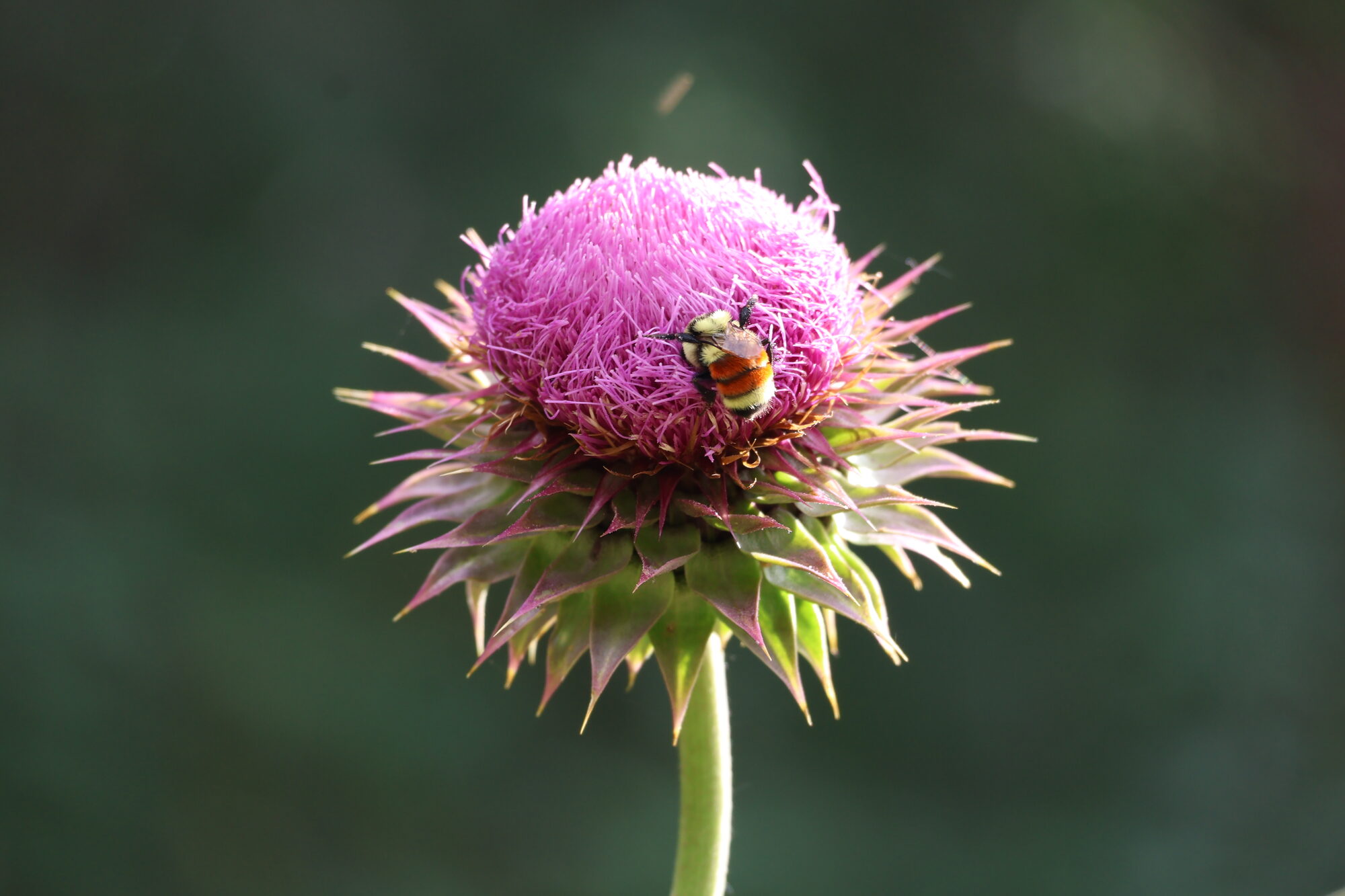
- Bumblebee on a thistle — 135mm
- Bird riding on a bison's back — 135mm
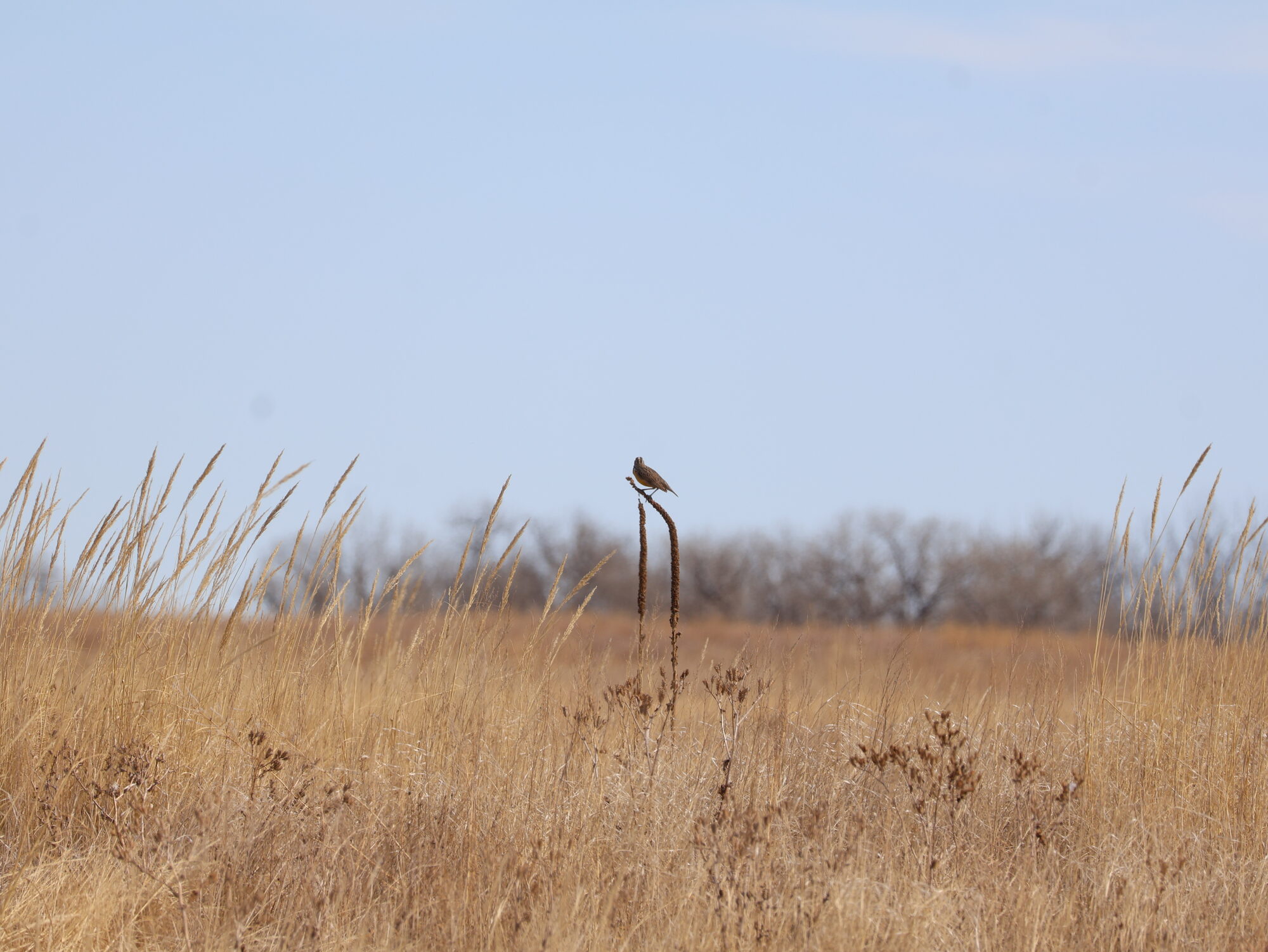
A Song Needs a Stage is a single bird on a seed stalk at 400mm, f/8, ISO 100, shot on my first outing with the 100-400. The lens made that frame, not the approach.
Two honest caveats. First, cropping a distant frame usually beats walking one step closer. A 24-megapixel file has room to lose, and a flushed bird has no file at all. Second, cheap telephoto zooms are slow — my 100-400 is f/8 at the long end, my 55-210 is f/7.1. You pay for that in ISO. Pay it.
Settings that let you shoot from far away
Long lens plus long distance means camera shake is magnified and your aperture is already as wide as it gets, so shutter speed and ISO are the only levers left. Start at 1/1000 for anything that can move suddenly, 1/2000 and up for wings, and let ISO go wherever it needs to. A noisy sharp frame prints. A clean blurred one doesn't.
The real numbers behind each of my wildlife frames, and how I choose them, are in Camera settings for wildlife, from my own frames.
Stay put instead of moving in
Pick a spot, sit down, and let the animals come into range. It's slower, it's less interesting to describe, and it's what actually produces frames.
The wren came from sitting in my grandparents' backyard. My grandpa loved watching it carry food into its home, and we watched it go in and out for probably an hour. Nobody stalked anything. The bird had a job and we were furniture.
The bison frames came from hours of watching a prairie herd. I'd never realized how much birds like to sit on a bison's back until I sat there long enough to see one refuse to leave no matter how much the bison shook.
Small subjects are where the instinct to lean in is strongest, and where sitting still pays fastest. On a hike near Morrison, Colorado, I heard a buzz go past and a bumblebee landed on the thistle right next to me — that's The Bee, at 135mm. Same with a blackbird that dropped into the reeds a few feet in front of me on one of my first camera walks. Neither was a stalk. Both were standing still in a place something wanted to be.
Practical version:
- Sit or kneel. A low profile reads as less threatening than a standing human, and your shooting angle improves at the same time.
- Put something between you and the animal — reeds, brush, a fence line — and shoot through a gap rather than over the top.
- Use electronic or quiet shutter, and turn off any beeps.
- Don't step off the trail to improve an angle. Crop instead.
Go back to the same place
Repetition is the least glamorous ethics strategy and the most effective one. If you know a spot, you know where animals already are, so you never have to push toward them.
There was a stretch where I hiked the same path every Sunday. I never saw a blue heron there until my last time — and then it was standing so still in the dry reeds I almost thought I was imagining it. That heron didn't need to be found. It needed me to keep showing up.
Don't wait for perfect light, either. The wren was working at 6:34 a.m., but the heron was standing in the reeds at 1:15 p.m., and eight of my eleven animal frames were made between 9 a.m. and 4 p.m. Go when you can go. Bare seasons help in their own way: with the reeds dry and the trees empty, a distant bird has less to hide behind.
The lines you don't cross
- No baiting, no food, no seed put out to draw a wild animal into frame.
- No call playback near nests or during breeding season.
- Don't approach nests, dens or burrows. Photograph them from where you found them.
- No drones over wildlife.
- Never get between young and an adult.
- Never box an animal against a cliff, water, a fence or a road. Always leave it an exit.
A nesting bird can be photographed from a distance it already tolerates. The moment your presence changes what the animal was doing, the photograph stops being worth it.
Prints from this piece