In the Rocky Mountains, the month you show up matters more than where you point the camera. Late September into early October is the aspen window, July and August bring wildflowers and afternoon thunderstorms, and winter trades color for low light and bare structure. Here's how the year actually behaves, and how it changes your exposure decisions.
The season decides the photo
In the Rockies, the calendar does more work than the map. Late September into early October is the aspen window. July and August give you wildflowers and afternoon thunderstorms. June is green and quiet with snow still sitting on the high slopes. Winter strips the hillsides down to structure and hands you low, angled light for most of the day.
Elevation moves all of it. The same species on the same mountain can be two or three weeks apart from bottom to top, so "peak color" isn't a date, it's a band that slides downhill through the fall. If you're planning a trip, pick the season first and then go find the subject. Doing it the other way around is how people end up standing at a famous overlook in the wrong month.
What each season actually gives you
Late spring. Snow lingers on the high slopes well after the valleys have dried out. The aspens are still bare trunks. On June 7 I photographed a hillside of them at 55mm, f/6.3, ISO 100, just after 4 p.m., and my note at the time just said: waiting for the aspens to change. White trunks against dark conifers is a real photograph on its own — it just isn't the one most people drive up for.
June green-up. Leaves fill in fast at mid elevation while snow is still visible higher up. That contrast — new green in the foreground, white above it — only exists for a few weeks.
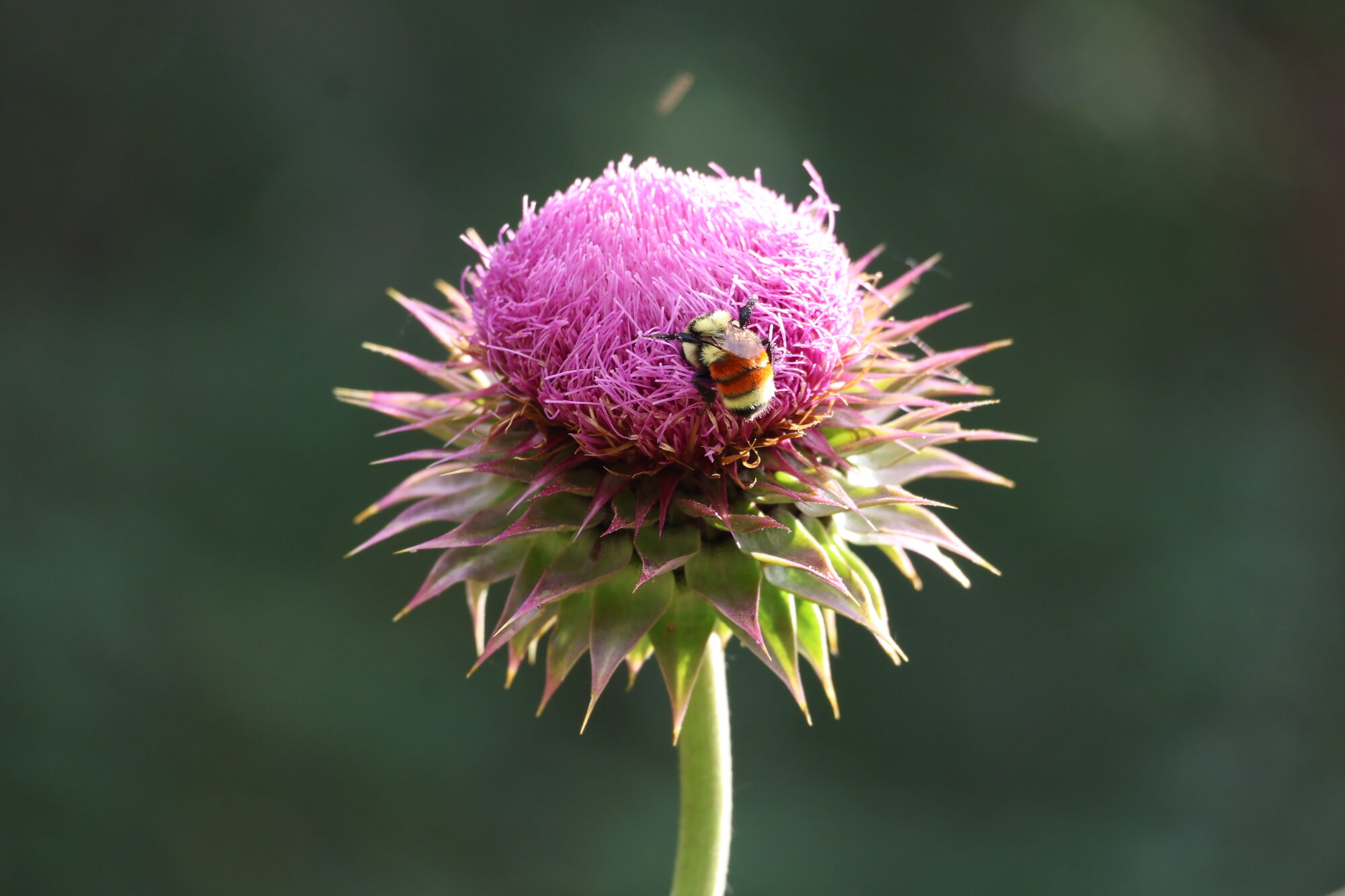
July and August. Wildflowers through the mid elevations, and the North American monsoon pushing moisture up from the south. On July 19 near Morrison, Colorado, I heard a bee go past me on a hike and watched it land on a thistle. That frame is The Bee, shot at 135mm, f/7.1, ISO 250. Summer in the Rockies gives you small, dense subjects like that as readily as it gives you big views.
Late September to early October. The gold. On October 4 I went out looking for changing aspens and found them on a rocky slope, shot at 105mm, f/7.1, ISO 500, at about 2 p.m. — flat afternoon light, yellow foliage against gray scree. That's Gold Rush, and it's the frame that convinced me fall color doesn't need golden hour. Yellow leaves hold their saturation in overcast or midday light better than almost anything else in the landscape, and the gray of broken rock makes them louder.
Winter. Short days, low sun angle, bare structure. In early January I was shooting pine cones against the sky at 3:55 p.m. and already needed ISO 1600 at 210mm. The light goes long and warm early, then it's gone.
Light at altitude behaves differently
There's less atmosphere between you and the sun up high, so the light is harder and the contrast range is wider than you're used to at sea level. Shadows go genuinely black. Snow and pale scree blow out before you notice. UV haze softens distant ranges, which is why the peak that looked enormous in person reads flat and gray on the back of the camera.
Two practical consequences:
- Expose for the highlights. Snow, white aspen bark, and sunlit granite are the first things to clip and the hardest things to recover. On open hillsides in good light I'm usually around f/7.1 at ISO 100, with shutter wherever that lands — 1/160 to 1/250 at 55–105mm.
- Golden hour is shorter than the sunset table says. In a valley, the ridge west of you blocks the sun long before official sunset. Check which direction your subject faces and assume you lose direct light early.
For anything handheld on a telephoto, keep shutter speed above 1/focal length and well above it for anything alive. At 210mm I'm typically at 1/400. For a bird at 400mm I've gone to 1/2500 and accepted ISO 6400 to get it. The exception is a subject that genuinely isn't moving — a heron standing still let me get away with 1/100 at 400mm, but that's stabilization plus luck, not a plan.
Afternoon storms, and shooting after them
From roughly early July through August, the daily pattern is clouds building by late morning and storms firing by early afternoon. The useful version of that forecast: be off exposed ridges and above-treeline terrain before noon. Lightning at altitude is the actual risk, not rain.
The reward comes after. The hour once a storm has moved through is often the best light of the day — broken cloud, wet ground that saturates every color, and sun coming in sideways under the deck. On July 19 the afternoon rain stopped and the sun came back out of the clouds onto a stretch of tall grass beside a trail. That's The Path Keeps Going, 57mm, f/7.1, ISO 320. Nothing about that frame was available twenty minutes earlier.
So build the storm into the plan instead of around it. Shoot early, sit it out somewhere safe, then go back out.
Wildlife: seasons, behavior, and distance
The regional calendar is fairly consistent. Elk rut runs from mid-September into October, which is also when bull elk are least predictable and most worth keeping distance from. Bighorn sheep and mule deer are findable year-round, and in winter a lot of animals drop to lower elevations where the forage is. Birds are the one subject that never has an off season.
The habit that matters more than the timing is this: watch long, and don't close the gap. One of my favorite frames came out of hours of sitting with a herd of bison. I had no idea how much birds like riding on a bison's back until I'd watched long enough to see one refuse to leave no matter how hard the animal shook. That relationship wasn't visible in the first ten minutes.
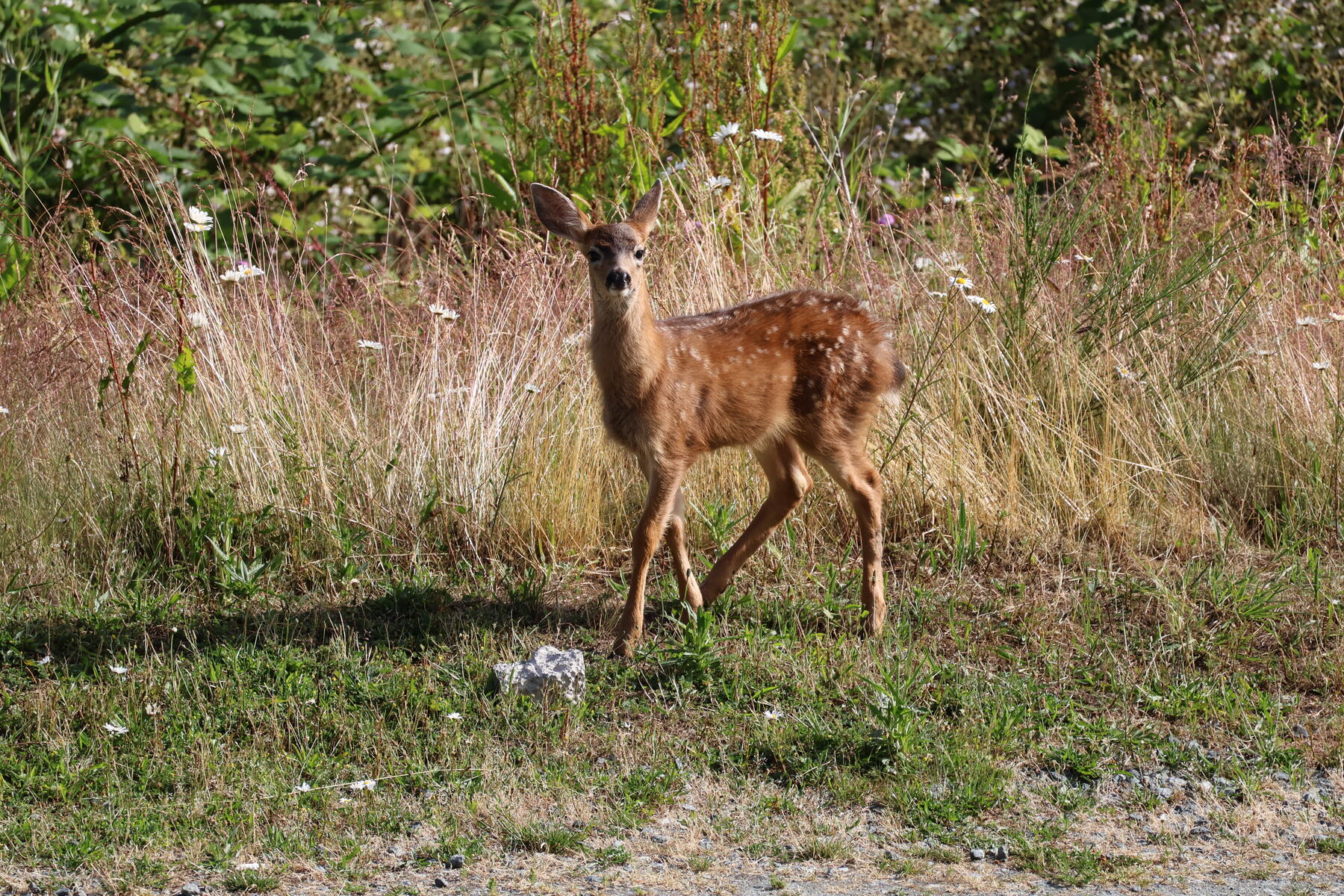
The other half is distance. Caught Noticing Me Back is a fawn on a July morning in Washington, shot at 210mm, 1/1000, f/7.1. I didn't move closer. The frame exists because the animal stayed relaxed, and it stayed relaxed because nothing approached it. Reach is what buys you that.
What's worth carrying
I shoot a Canon R50 with two lenses, and between them they cover almost everything I want in the mountains.
- A mid-range zoom handles the large majority of mountain landscapes. Most of my wide frames are at 55–105mm, not ultrawide — a longer focal length compresses ridgelines and makes a distant peak read as big as it felt.
- A long telephoto for wildlife you shouldn't walk toward. My 100–400mm is slow at f/8 on the long end, which means high ISO in anything but open light. That's the trade for reach, and it's worth it.
- Spare batteries, kept warm. Cold drains them fast. Inside jacket, not in the pack.
- Something to clean the lens. Between trail dust and sudden rain, the front element doesn't stay clean for long.
You don't need a tripod for most of this. Daylight at altitude is plentiful enough that handheld at ISO 100 is normal.
When the big view isn't working
Some days the wide shot just isn't there. Midday light is flat, haze has eaten the distance, the leaves haven't turned. The view doesn't owe you anything.
That's when I go small. A hollow in a tree trunk at 210mm. A burrow in the forest floor. Pine cones against open sky. The Bee is the clearest example — one thistle, one bumblebee, on a hike where the landscape wasn't doing anything special. Small subjects don't care about haze or the sun angle, and they're usually within ten feet of where you're already standing.
It's also the part of mountain photography that stays yours. Anyone can stand at the same overlook. What you notice on the way there is the part that's yours.
Prints from this piece