Manual mode, 1/1000s, aperture wide open, Auto ISO with the ceiling set to 6400, continuous AF, raw. Dial that in before you leave the house and you'll come home with sharp files of most animals you meet on a walk.
The baseline, and the frames behind it
Manual mode, 1/1000s, aperture wide open, Auto ISO with the ceiling set to 6400, continuous AF, raw. Dial that in before you leave the house and you'll come home with sharp files of most animals you meet on a walk.
Everything below comes out of the EXIF of my own wildlife frames. The body is a Canon EOS R50 — APS-C, so a 400mm lens frames like a 640mm would on full frame. The lenses are an RF-S 55-210mm f/5-7.1 and an RF 100-400mm f/5.6-8. Both handheld, both slow. Across those frames the numbers land like this:
- Focal length: 135mm to 400mm
- Shutter: 1/100s to 1/2500s
- Aperture: f/7.1 to f/8
- ISO: 100 to 6400
If your kit is a crop body and a budget telephoto zoom, that's close enough to mine that these numbers should transfer straight over. If you're on a 600mm f/4, you have options I don't.
Shutter speed: the only number you really choose
On a slow zoom, shutter speed is the dial that actually decides whether the frame works. Aperture is fixed by the lens and ISO follows along behind. So think in terms of what the animal is doing.
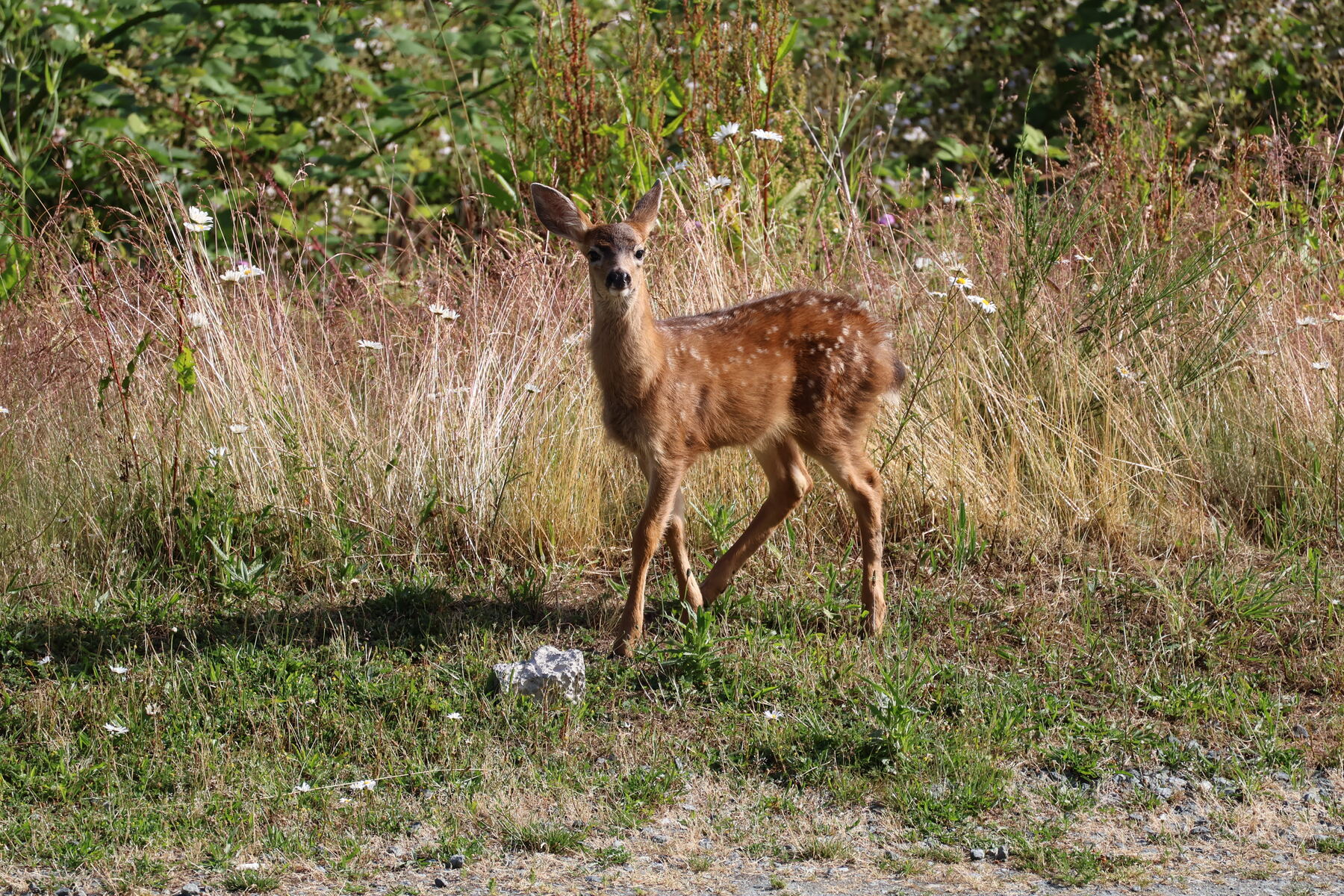
A fawn on a gravel path at 210mm, bright July morning: 1/1250s, then 1/1000s a half-minute later when it turned its head. That's Caught Noticing Me Back. 1/1000s was enough to freeze the head turn and it kept ISO down at 400. Nothing was gained by going faster.
A wren at 400mm with an insect in its beak, 6:34 in the morning: 1/2500s. Feeding birds move in short violent bursts and 1/1000s won't hold them.
A bird riding on a bison's back at 135mm: 1/320s.
A heron in dry reeds at 400mm: 1/100s. It was so still I almost thought it was a hallucination. Handheld at 400mm that only works because the lens has image stabilization and because the bird was doing nothing at all — but it works, and at ISO 100.
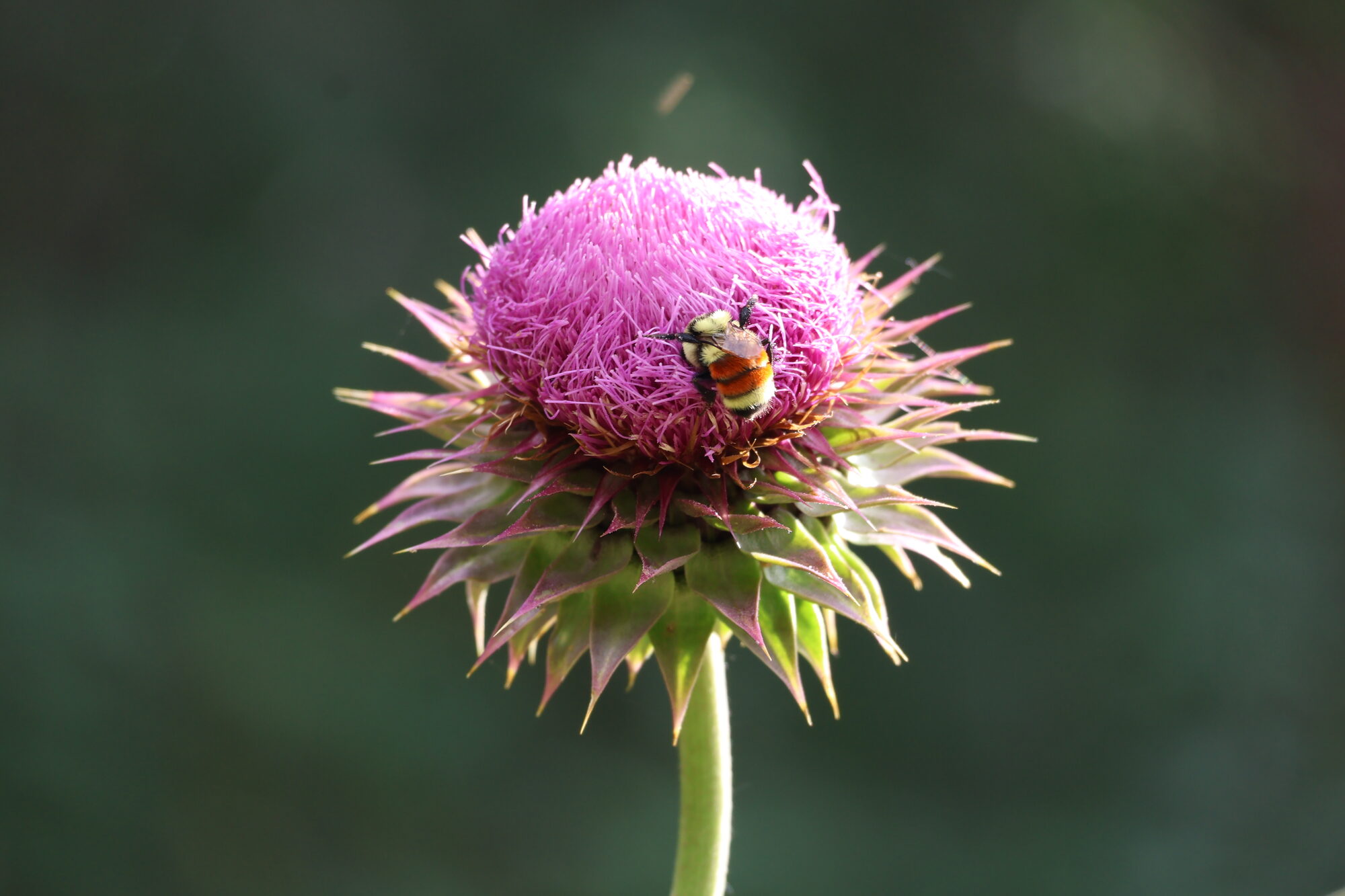
The Bee is the same idea at close range. 135mm, 1/125s, a bumblebee on a thistle near Morrison, CO. With a small subject close in, waiting for the pause between movements beats cranking the speed and losing the light.
Rough rules I'd give you:
- 1/1000s as the default for anything alive and alert.
- 1/2000s and up for flight, feeding, or any fast repeated motion.
- 1/250s or slower only when the animal is genuinely still and your hold is steady. You'll throw some frames away. The keepers are clean.
Aperture: mostly decided for you
At the long end, the 55-210mm opens to f/7.1 and the 100-400mm opens to f/8. That's it. That's why nearly every wildlife frame in my library reads f/7.1 or f/8 — at the long end, that's just wide open.
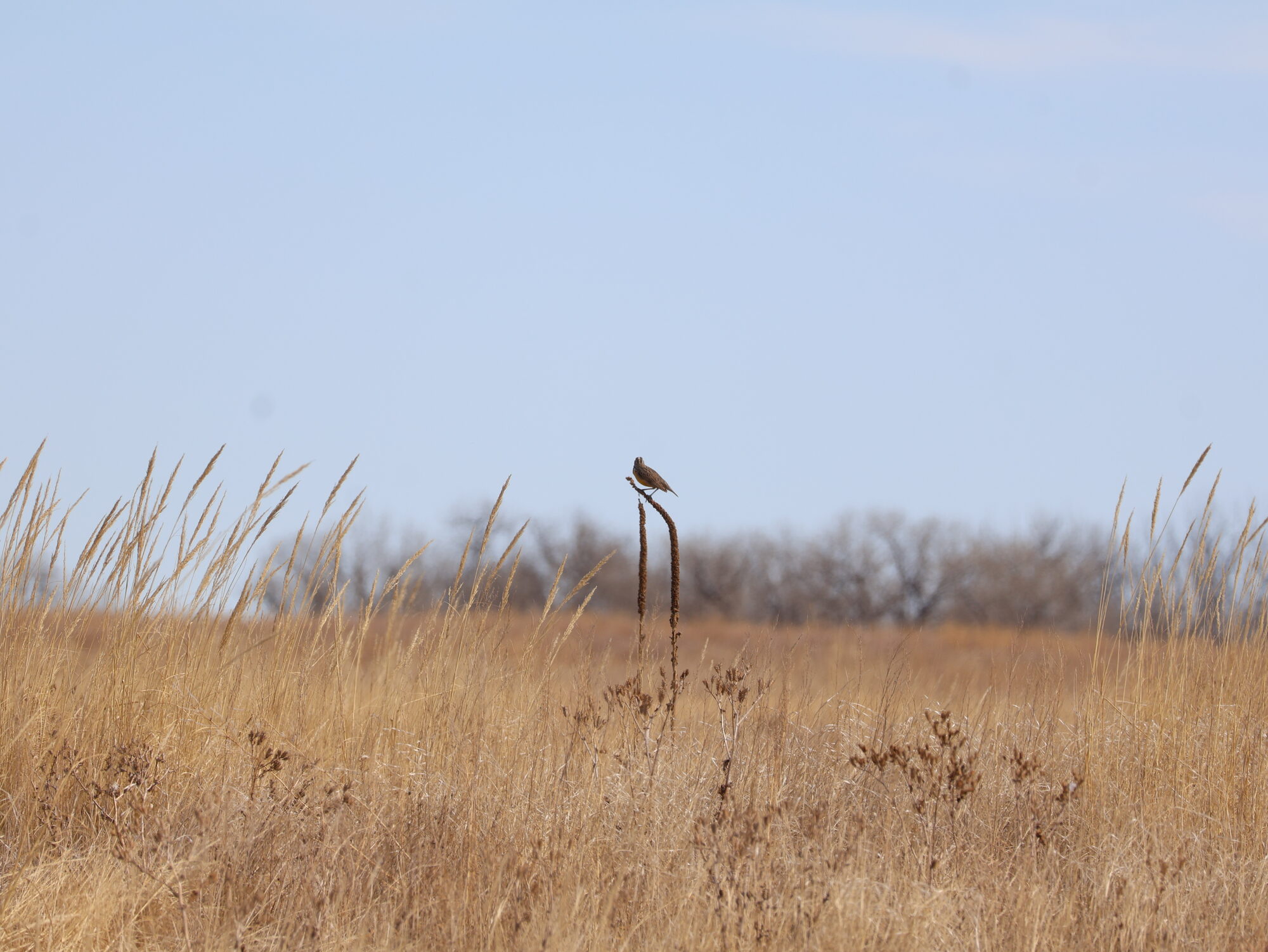
Practically, it means you don't get the background melt of a fast prime. Distance does that work instead. Get closer to the subject, and put the subject farther from whatever's behind it. A Song Needs a Stage is a small bird on a seed stalk at 400mm against open sky, shot at f/8 and ISO 100 — the sky is the separation, not the aperture.
The other case is a bird on a bison at 135mm, f/8 — two subjects at different distances. At f/8 there's enough depth to hold both. A prime at f/2.8 would have made you pick one.
ISO: pick a ceiling, then stop thinking about it
The spread in my files is wide. ISO 100 on bright open prairie in February. ISO 400 to 640 on a July morning in tall grass. ISO 6400 at 6:34 a.m. at 400mm, because f/8 and 1/2500s in early light doesn't leave the camera anywhere else to go.
Noise you can work on in raw. Motion blur is permanent. Current noise reduction tools make that trade easier than it used to be, which is a good reason to set the ceiling higher than instinct says.
Autofocus, drive mode and the settings you set once
- Continuous AF (Servo), always. One-shot is for landscapes.
- Animal or eye detection if your body offers it. It's faster than you are.
- Single point or a small zone for a bird in branches. A wide zone will lock onto the nearest twig.
- Back-button focus if the body supports it — it separates focusing from the shutter so a static subject stays locked while you recompose.
- Electronic shutter, burst mode. Feeding and head turns happen between frames.
- Raw. You'll want the latitude when ISO is high.
Settings won't get you the frame
A blackbird flew into the reeds directly in front of me and sat there. A fawn looked up at the exact second. A bee landed on the flower next to me. None of that is a setting.
What a baseline does is make sure the camera isn't the reason you missed it. 1/1000s, wide open, Auto ISO — you can shoot from that in about a second, and fix it afterward if the animal turns out to be standing still.
Prints from this piece